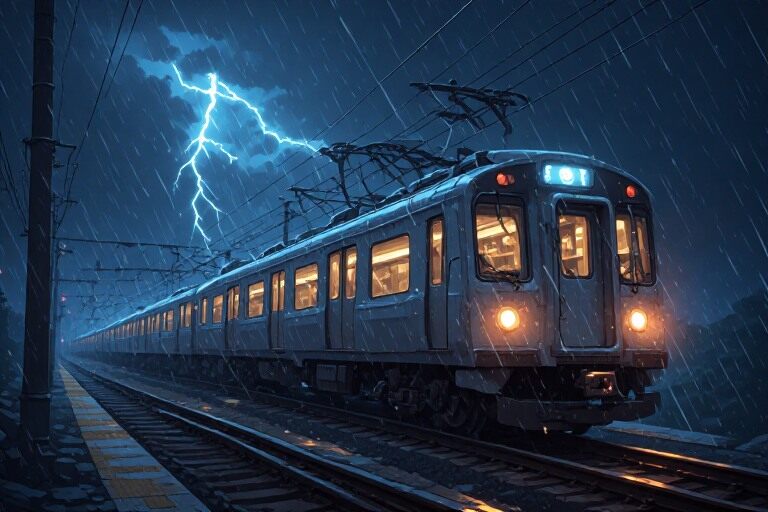
Tokyo to Osaka: A Journey Through the Storm
Traveling from Tokyo to Osaka is usually a smooth, futuristic experience. But on this particular day, nature decided to add a little drama. A powerful thunderstorm rolled across Japan, turning the skies dark, the rain heavy, and the entire landscape into a cinematic backdrop. Yet right through the chaos, the bullet train remained unstoppable.
This wasn’t just any train. It was the famous high-speed route covering roughly 515 kilometers, connecting Tokyo and Osaka in about 2 hours, slicing through the storm at speeds reaching up to 320 km/h. From the inside, the experience felt like sitting inside a calm capsule while the world outside turned into a blur of lightning, rain, and motion.
Speed, Silence, and Storms Outside
The windows were painted with streaks of water and light, making the scenery look almost like a digital painting in motion. Despite the thunder roaring outside, the train stayed incredibly steady no shaking, no hesitation just smooth, futuristic precision. It felt less like travel and more like time compression on rails.
Passengers inside enjoyed a strange contrast: warm lighting, quiet seats, and comfortable interiors versus an outside world that looked like it was being rewritten by the storm itself. Every flash of lightning briefly revealed fields, cities, and bridges before they vanished again into rain.
A Front-Row Seat to Nature’s Performance
And then there’s the price: around $90 USD for one of the fastest and most dramatic journeys in the world. Compared to the experience, it felt almost unreal like paying for a front-row seat to a moving weather show at 320 km/h.
As the train crossed halfway, the storm began to feel less like an obstacle and more like part of the entertainment. The rhythm of the rails, the speed, and the thunder outside created a unique harmony of technology and nature.
Finally, after two hours of high-speed travel, the train slowed as Osaka approached. The storm still raged in the distance, but the city lights began to break through, signaling arrival. Tokyo was behind, Osaka was ahead, and the storm was left somewhere between kilometers, speed, and steel.
It was a reminder that in Japan, even bad weather can become part of a perfect journey.